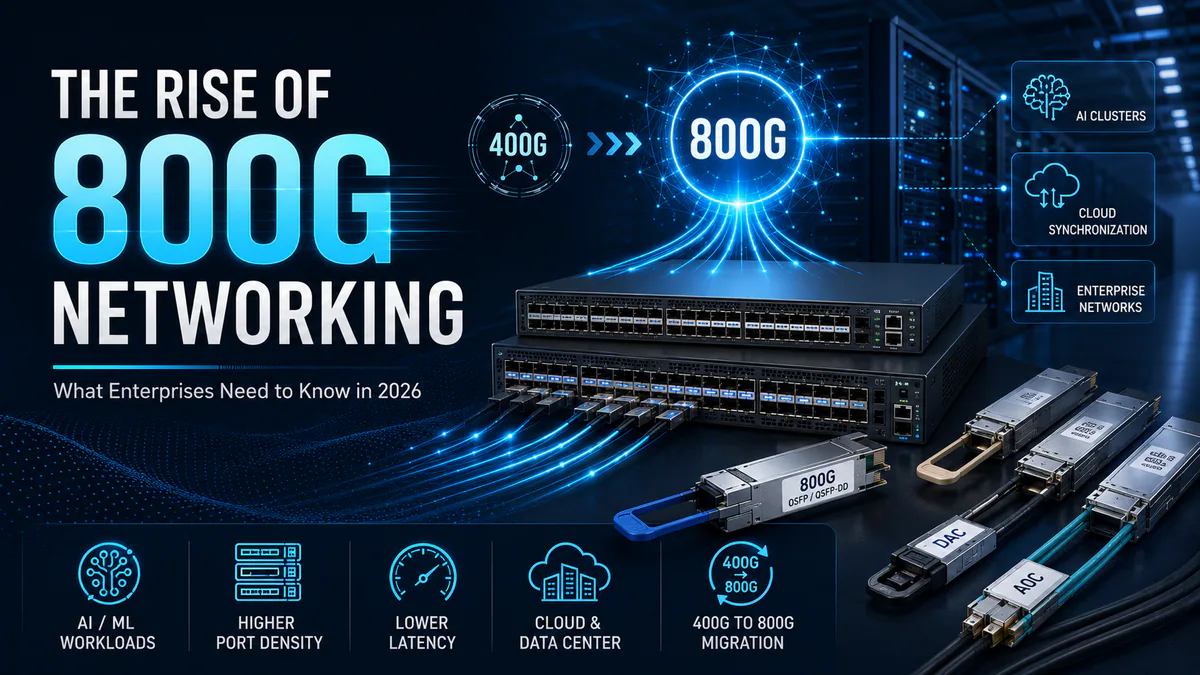
As the digital landscape evolves, the demand for data transmission speed has outpaced the capabilities of legacy infrastructure. We are currently witnessing a pivotal shift in how the enterprise network handles massive data flows required for Artificial Intelligence (AI) workloads, high-performance computing (HPC), and global cloud synchronization. In 2026, 800G networking is no longer a futuristic concept reserved for hyperscalers; it is becoming a practical necessity for large-scale enterprises looking to maintain competitiveness. This article delves into the current state of high-speed connectivity, analyzing why the adoption of 800G technology is a critical 2026 trend that IT leaders must address now.
The Evolution of High-Speed Connectivity
To understand the significance of 800G networking, one must look at the progression of Optical Transport. For years, 10G and 40G were the standard. Following the surge of 100G and 400G, the industry faced a bottleneck. Data centers were consuming bandwidth faster than aggregation switches could forward traffic. While 400G optics and switches were widely available, the aggregate throughput required for next-generation AI training clusters demanded higher densities.
Enter 800G. By doubling the line rate of 400G, 800G provides the capacity to connect servers directly to aggregation layers without congesting the network fabric. In the context of modern network infrastructure, this is not merely an upgrade in speed; it is a fundamental architectural change designed to support the exponential growth of GPU utilization in AI training and inference.
Market Drivers for 2026 Adoption
Several factors are pushing enterprises to adopt 800G solutions in the coming year.
- AI and ML Workloads: Large Language Models (LLMs) require massive interconnect bandwidth for distributed training. The all-optical switches of 800G networking reduce packet loss and latency, crucial for distributed computing environments.
- Consolidation of Racks: Higher port density means fewer switches in the rack. This saves physical space and lowers Power Usage Effectiveness (PUE), a major metric for data center sustainability.
- Hyperscale Standards: As hyperscalers move to 800G, smaller enterprises need compatible equipment to maintain interoperability and cost-efficiency.
- Latency Sensitivity: For real-time applications like autonomous transport and financial trading, the reduced hops and faster forwarding rates of 800G networks significantly lower end-to-end latency.
Comparing Legacy and Modern Capabilities
The following table illustrates the technical and operational differences between 400G and 800G solutions relevant for network planners in 2026.
| Feature | 400G Era (2024-2025) | 800G Era (2026+) |
|---|---|---|
| Throughput | 400 Gbps per port | 800 Gbps per port |
| Lane Rate | Typically 25 Gbaud per lane | 50 Gbaud per lane |
| Power Consumption | High, but improving | Optimized with newer PAM4 |
| Cabling | 200G+ DAC or 8x50G DAC | 800G DAC, 112G PAM4, 800G DR4 |
| Use Case | Standard Server-to-Switch | High Density AI Clusters |
| Port Density | Lower (fewer ports per U) | Higher (more ports per U) |
Technical Challenges and Solutions
Moving from 400G to 800G introduces specific engineering challenges that the enterprise network team must anticipate. The physical layer requirements become more demanding as the baud rate increases.
Power Consumption and Thermal Management
One of the most pressing concerns for IT buyers is power. As bit rates increase, so does the power drawn by optical transceivers and switch ASICs. Vendors continue to optimize silicon photonics and thermal design to improve power efficiency. For a typical 400G QSFP-DD module, power draw is around 3W to 5W. 800G modules often target similar or slightly higher wattages per Gbps, but with higher density, the total rack power requirement is managed through smarter DC-DC conversion and heat dissipation designs.
Cabling Constraints
Transitioning to 800G requires checking cabling compatibility. Copper Direct Attach Copper (DAC) cables for 800G generally require shorter reach and higher quality shielding to prevent signal degradation. Optical solutions like 800G DR4 (850nm) or 800G FR4 are used for longer reach. Enterprises must inventory their existing fiber and ensure the patch panels support the specific MSA (Multi-Source Agreement) required for 800G optics.
Vendor Ecosystem Compatibility
In the network infrastructure landscape, interoperability is key. Many enterprises use a mix of vendors. 800G networking standards, governed by organizations like OIF and IEEE, ensure that transceivers from different manufacturers can work with switches from different brands. This prevents vendor lock-in and allows for flexible architecture scaling.
Planning Your 2026 Network Upgrade
If your organization is looking to embrace the 2026 trends in networking, starting the planning phase now is essential.
Assessing Current Inventory
Before ordering new gear, audit your current inventory. Do you have existing 400G switches that can be upgraded via software? Or will you need new line cards? Check fiber patch panel compatibility. If you are moving from 400G to 800G, ensure your fiber links have enough margin for the new optics.
Budgeting for the Shift
Costs are shifting as 800G volume ramps up. In 2026, the price gap between 400G and 800G components should narrow significantly. While initial CAPEX for 800G is higher, the reduced hardware count and power savings (OPEX) provide a strong ROI. Compare the Total Cost of Ownership (TCO) of staying with 400G versus upgrading to 800G to ensure financial efficiency.
Scalability Roadmaps
Plan for future-proofing. 800G is not a static endpoint; it is an evolution of the network fabric. Ensure your architecture allows for seamless upgrades. As more 400G ports are replaced with 800G, your switch’s port density and throughput capabilities should increase to match the aggregate demand.
Conclusion
The transition to 800G is a definitive step for enterprise networks in 2026. By adopting this technology, you ensure your infrastructure can handle the insatiable appetite for AI and cloud data. Whether you are expanding a network infrastructure for a data center expansion or upgrading for AI workloads, the move to 800G is the prudent choice for forward-thinking IT departments.
Recommended Product Categories
- 800G QSFP-DD DR4/FR4 Optics – Long-reach optical transceivers for leaf-spine and data center interconnect applications
- 800G Active Optical Cables – Integrated optical cabling for high-density rack and row-level links
- 800G-Capable Data Center Switches – Scalable switching platforms for AI clusters and high-density aggregation
- 800G DAC Cables – Copper direct attach cables for short-reach server and switch connectivity