In the rapidly evolving landscape of enterprise networking, understanding the physical and electrical differences between optical transceivers is paramount for architects and network engineers. As data centers scale and bandwidth demands increase, the choice between SFP+ and QSFP28 form factors often dictates the architectural decisions of your network design. This guide provides a comprehensive technical breakdown of these two industry-standard modules, helping you select the appropriate network hardware for your specific bandwidth requirements.
Understanding Optical Transceivers
Before diving into the specifics of form factors, it is essential to understand the function of a transceiver. An optical transceiver is an electronic device that converts electrical signals into optical signals (and vice versa) to transmit data over fiber optic cables. These modules plug directly into network interfaces, such as switches and routers, providing connectivity for fiber optic or copper cabling.
Historically, transceivers have standardized around the hot-pluggable form factor introduced by SFF (Small Form Factor). Over the years, the form factor has evolved to meet higher speeds, leading to the current dominance of SFP+ for 10G applications and QSFP28 for 100G/200G applications. Knowing when to deploy which form factor ensures optimal port utilization and cost efficiency.
SFP+ Transceivers: The 10G Workhorse
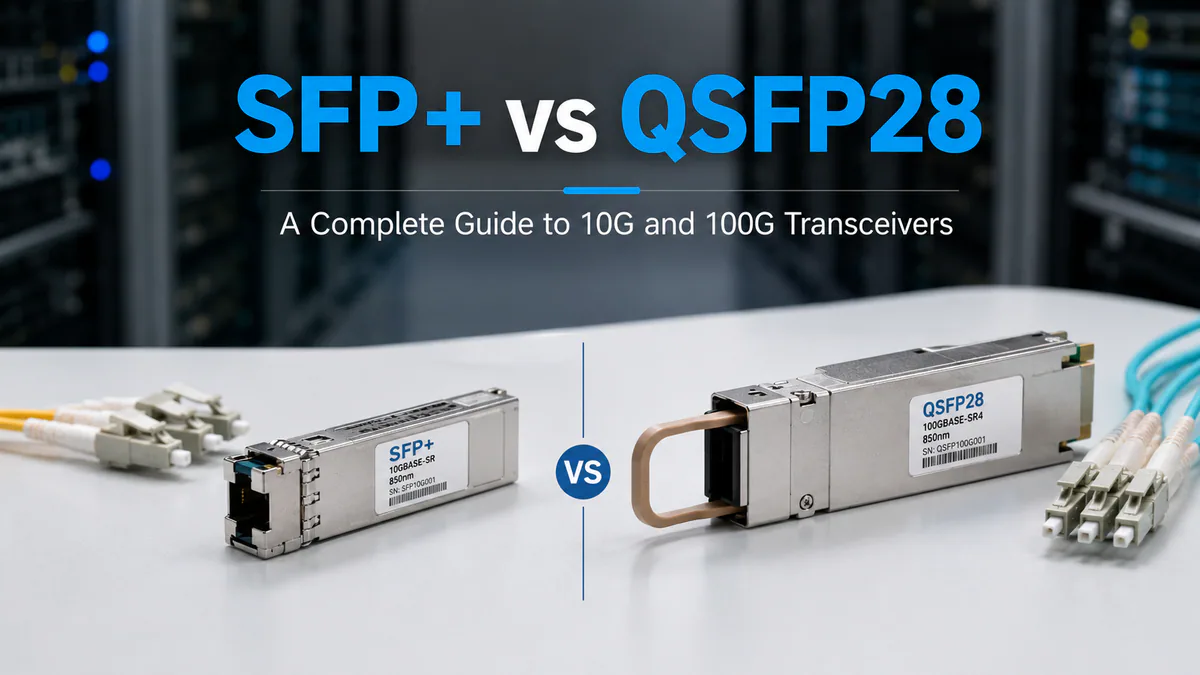
The SFP+ (Enhanced Small Form-factor Pluggable) module is the standard form factor for 10 Gigabit Ethernet. Introduced to supersede the older SFP (1G) module, it was designed to handle higher data rates while maintaining a compact physical footprint.
Technical Specifications
- Data Rate: Supports 10 Gbps.
- Physical Form Factor: Small (SFP+ size).
- Pin Count: Typically 20 contacts.
- Common Standards: IEEE 802.3ba, InfiniBand FDR.
- Fiber Types: Compatible with OM3/OM4/OM5 multimode fiber and single-mode fiber (LSM/LZM).
Advantages and Use Cases
The primary advantage of SFP+ is its cost-efficiency. It offers the best price-to-performance ratio for 10G applications. In campus networks, access switches, and mid-backbone links, SFP+ remains the preferred choice. Because the physical dimensions are smaller, switch vendors can pack a higher density of 10G ports into a 1RU chassis compared to larger form factors.
However, SFP+ is inherently limited to 10Gbps. If you require 100Gbps aggregation, SFP+ cannot be used directly. While a single SFP+ port is cheaper than a QSFP28 port, the aggregate bandwidth of four SFP+ ports in a cage is still slower than a single QSFP28 port without the latency overhead of multiplexing.
QSFP28 Transceivers: Scaling to 100G and Beyond
QSFP28 (Quad Small Form-factor Pluggable 28) is the successor to the QSFP+ (40G) standard. While QSFP+ utilizes 24 pins, QSFP28 introduces additional pins and power requirements to support the 100 Gbps data rate.
Technical Specifications
- Data Rate: Supports up to 100 Gbps (often using four 25 Gbps lanes).
- Physical Form Factor: Larger and more robust.
- Pin Count: Typically 40 to 48 contacts.
- Common Standards: IEEE 802.3bm, IEEE 802.3cd.
- Fiber Types: Compatible with various fiber types, including single-mode and multimode.
Advantages and Use Cases
QSFP28 is the standard for high-speed backbone networks, cloud computing clusters, and high-performance computing (HPC) environments. Its ability to carry 100 Gbps over a single optical fiber makes it ideal for data center core layers and aggregation switches.
The 100G standard utilizes a Quad-Channel architecture, which transmits four independent 25 Gbps channels simultaneously. This allows for better signal integrity and lower latency over fiber compared to aggregating multiple lower-speed lanes. However, QSFP28 modules are generally more expensive and consume more power than their SFP+ counterparts.
Direct Comparison: SFP+ vs QSFP28
To visualize the differences at a glance, here is a comparative table highlighting the key technical distinctions between these two critical form factors.
| Feature | SFP+ (SFP28) | QSFP28 (QSFP-DD precursor) |
|---|---|---|
| Max Data Rate | 10 Gbps | 100 Gbps |
| Port Density | Higher (Smaller form factor) | Lower (Larger form factor) |
| Pin Count | 20 pins | 40 pins |
| Typical Usage | Access / Aggregation Layers | Core / High-Performance Clusters |
| Power Consumption | Lower | Higher |
| Cable/Module Cost | Cheaper | More Expensive |
| Lane Architecture | Single Lane (10G) | Quad Lane (4 x 25G) |
Protocols and Standards: Ensuring Compatibility
It is crucial to understand that “form factor” compatibility does not guarantee “protocol” compatibility. SFP+ and QSFP28 modules operate under different physical layer specifications.
SFP+ Standards
SFP+ modules generally operate on widely adopted Ethernet standards. They are supported across major switch ecosystems for applications like:
- 10GBASE-SR: 10G Ethernet over OM3/OM4 Multimode fiber.
- 10GBASE-LR: 10G Ethernet over single-mode fiber.
- 10GBASE-CR: 10G Ethernet over copper DAC (Direct Attach Copper).
QSFP28 Standards
QSFP28 modules operate on IEEE 802.3bm/802.3cd standards and are essential for:
- 100GBASE-SR4: 100G Ethernet over OM4/OM5 multimode fiber.
- 100GBASE-LR4: 100G Ethernet over single-mode fiber.
- 100GBASE-SR8: 100G Ethernet over long-reach single-mode fiber.
Use Cases: Choosing the Right Architecture
Deciding whether to use SFP+ or QSFP28 often boils down to your network design goals.
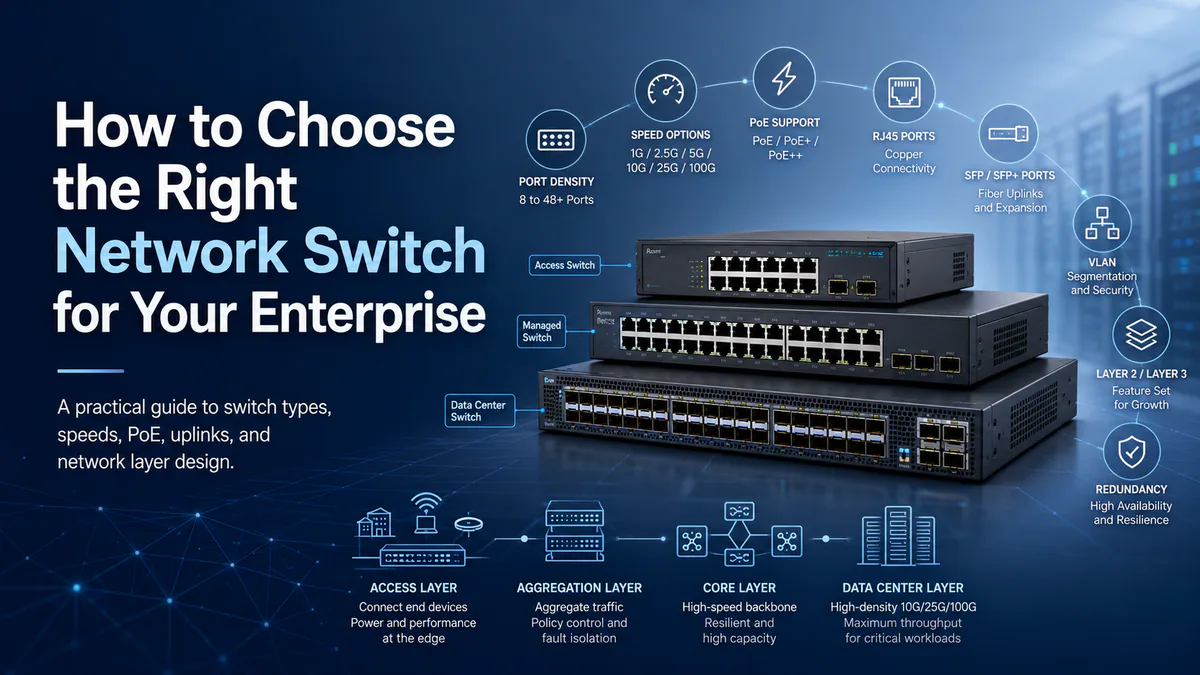
Access Layer: SFP+ Dominance
In the access layer (the edge of the network connecting end devices), 10G uplinks are sufficient for many scenarios. Here, short-reach 10G SFP+ SR optics provide reliable multimode connectivity at a lower cost. If you need copper connectivity for short distances, SFP+ DAC cables offer a plug-and-play option with high durability.
Aggregation/Core Layer: QSFP28 Dominance
As you move up the hierarchy to aggregation and core layers, the demand for speed increases. A single QSFP28 port offering 100Gbps reduces the number of ports needed compared to four SFP+ ports. QSFP28 SR4 or LR4 modules are common choices for these high-speed backbones, reducing cabling complexity and port count on your switches.
Cost and Power Consumption
One of the most significant considerations in a large-scale deployment is the Total Cost of Ownership (TCO).
- Module Cost: While a QSFP28 port on a switch is more expensive than an SFP+ port, the module itself is often more expensive too. However, you often need fewer QSFP28 ports to achieve the same aggregate bandwidth. For example, four SFP+ ports equal the bandwidth of one QSFP28 port, but four modules cost more than one.
- Power Consumption: SFP+ modules typically draw less power, which is beneficial for energy-efficient designs, especially in large data centers with strict PUE (Power Usage Effectiveness) targets. QSFP28 modules draw significantly more power to drive the higher speeds.
- Cabling: 100G QSFP28 modules often require 12-fiber MPO connectors (for multimode) or single-fiber connections (for single-mode). 10G SFP+ modules use LC duplex fibers. MPO cables are more expensive than standard duplex LC cables, which impacts the overall cabling budget.
Migration Paths: From 10G to 100G
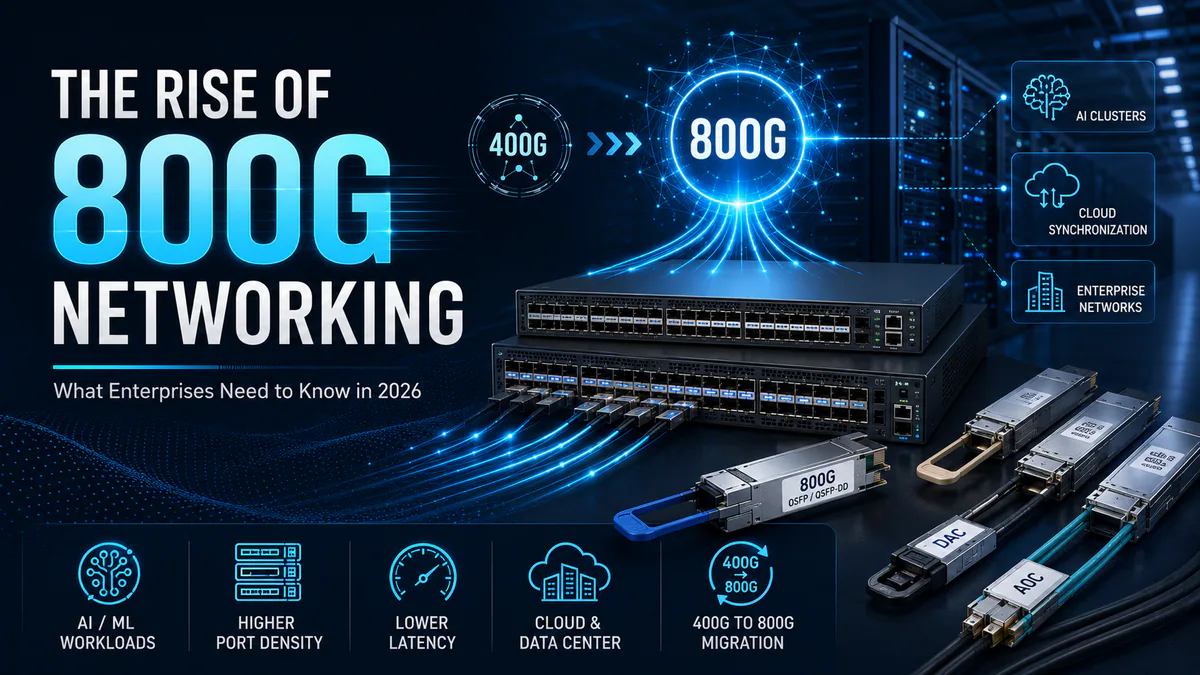
As you upgrade your network, you might face the challenge of mixing speeds. A common migration path involves utilizing a QSFP28 to 4x SFP+ breakout cable. This cable allows you to use a single 100G QSFP28 port on a core switch and breakout it into four 10G SFP+ ports to connect to access switches. This hybrid approach allows for scalability without replacing existing cabling immediately.
However, be aware of the cost implications. Breaking out a 100G link into four 10G links can increase the overall cabling and port cost. It is often more cost-effective to simply use a 10G SFP+ transceiver in an 10G SFP+ slot if your access layer switches do not support breakout cables or do not need the full 100G capacity.
Conclusion: Selecting the Right Transceiver
In summary, the choice between SFP+ and QSFP28 is not just about raw bandwidth; it is about architectural density, port cost, and future scalability.
- Choose SFP+ if you are operating in the access layer, have budget constraints, or require lower power consumption.
- Choose QSFP28 if you are deploying in the core layer, need to support 100G speeds, and require a dense, high-performance network.
Both standards are essential for modern data center infrastructure, and your network design should reflect the traffic patterns and performance requirements of your specific deployment.
Recommended Product Categories
Explore the full range of high-performance networking solutions available to support your infrastructure upgrades:
- 10G SFP+ SR/LR Transceivers: 10G optics for short-reach multimode or longer-reach single-mode links.
- 100G QSFP28 SR4/LR4 Transceivers: 100G optics for aggregation and core-layer links.
- SFP+ DAC Cables: 10G Direct Attach Copper cables for short copper uplinks.
- QSFP28 DAC/AOC Cables: 100G copper or active optical cables for rack-level and row-level links.
By carefully evaluating these factors, you ensure that your network hardware investment supports your business growth and scalability goals.