In the rapidly evolving landscape of enterprise networking, the backbone of your infrastructure relies heavily on the quality of your cabling. As bandwidth demands surge with the adoption of cloud computing, 5G connectivity, and data-intensive applications, selecting the correct fiber optic cable becomes a critical decision for IT architects and network engineers. A misstep in this selection process can lead to signal degradation, reduced uptime, and increased total cost of ownership (TCO).
Whether you are designing a new network or upgrading an existing backbone, understanding the nuances between single-mode and multimode fiber is essential. This guide walks you through the technical specifications, cost-benefit analyses, and real-world scenarios necessary to make an informed choice that aligns with your data center performance goals.
Understanding the Fundamental Fiber Types
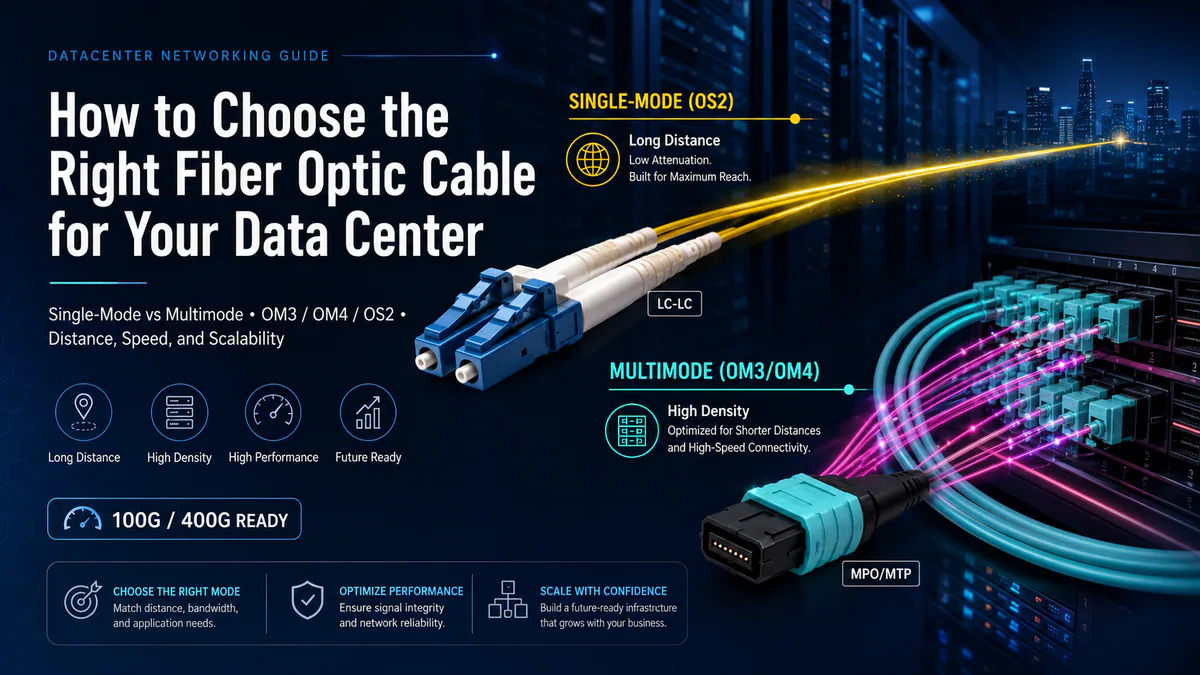
At the heart of any optical connection is the choice between Single-Mode Fiber (SMF) and Multimode Fiber (MMF). These two categories serve different purposes based on distance and bandwidth requirements.
Single-Mode Fiber (SMF)
Single-mode fiber utilizes a core diameter typically around 9 microns. Because the core is small, it allows only a single path of light to travel through the cable. This minimizes modal dispersion, a phenomenon where light pulses spread out, causing data distortion. SMF is generally used for long-distance transmission. In a data center context, single-mode is ideal for inter-rack connections or links extending beyond 300 meters. When paired with 1310nm or 1550nm lasers, SMF supports distances ranging from 2km up to 40km or more.
Multimode Fiber (MMF)
Multimode fiber has a larger core, typically 50 microns or 62.5 microns. This larger core allows multiple light modes (paths) to bounce through the cable simultaneously. While this was once the standard for short-range data links, the industry has shifted towards 50-micron MMF for higher speeds. MMF uses 850nm VCSEL transceivers, which are more cost-effective for short distances. It is the preferred choice for intra-rack and short intra-row connections where cost and density are prioritized over maximum reach.
Deep Dive: Multimode Fiber Standards (OM3 vs. OM4)
When working with shorter distances within a rack or between nearby racks, multimode fiber is the standard. However, not all MMF is created equal. The industry primarily recognizes OM3 and OM4 standards, though newer OM5 standards are emerging for high-capacity 400G+ applications.
OM3 Fiber
OM3 is an Laser Optimized Multimode (Laser Optimized) cable. It is designed to support 10G Ethernet speeds over distances up to 330 meters. Historically, this was the go-to cable for data center uplinks. However, as transceiver rates increased, OM3 began to struggle at higher speeds.
OM4 Fiber
OM4 is essentially an enhanced version of OM3, doubling the bandwidth-distance product. It supports 10Gbps up to 550 meters and is crucial for data center implementations using 40G and 100G transceivers. For a 100G SFP28 SR4 transceiver, you can reach approximately 100 meters with OM4 compared to just 50 meters with OM3.
Comparison Table
| Specification | OM3 | OM4 |
|---|---|---|
| Bandwidth-Distance Product | 2000 MHz.km | 4700 MHz.km |
| Max Reach @ 10G | 330 meters | 550 meters |
| Max Reach @ 40G/100G | Limited | 100 meters (100G) |
| Cost | Lower | Moderate |
| Use Case | Legacy 10G, Low Budget | Modern 100G, High Density |
While OM3 is cheaper, purchasing it today might limit your upgrade path. Fiber optic cable selection should always consider the lifespan of your hardware. Choosing OM4 now ensures your cables will support 25G or 50G transceivers without requiring a full cable replacement.
Selecting Single-Mode for Long Haul
For any distance exceeding the capacity of multimode, single-mode is the mandatory choice. In data center environments, this is typically found in the backbone or “spine” of the network architecture.
Key Advantages
- Long Distance: Single-mode handles 10Gbps and 40Gbps signals over several kilometers, enabling connections between remote offices or large campuses.
- Cost of Transceivers: While the fiber cable itself costs more than MMF, the single-mode laser transceivers (1310nm) are often cheaper per meter than the multimode VCSELs (850nm) required for the same speed over short distances.
- No Mode Partition Noise: Single-mode eliminates modal dispersion entirely, ensuring signal integrity over vast distances.
Typical Scenarios
- Connecting the data center to the metro fiber network.
- Interconnecting two separate buildings within a campus.
- Spine-Leaf architecture where the spine layer requires high bandwidth over longer distances.
The Critical Role of Connectors and Transceivers
The cable is only half the equation. The quality of the connectors and the matching transceivers dictates whether your fiber optic cable will perform optimally.
Connector Types
The industry standard is the LC connector due to its small form factor, which allows for higher port density on data center switches.
- LC to LC: Standard for most modern applications.
- MPO/MTP: Used for high-density 40G/100G parallel optics (like QSFP+ or QSFP28).
- E2000: Used in specific metro applications but less common in general data center racks.
When selecting your fiber optic cable, ensure the patch cord ends match your SFP/SFP+ ports. An LC-LC 10m patch cord using OM4 fiber is ideal for 100G links in a row. Conversely, an LC-LC single-mode patch cord is necessary for connecting to external 100G-LR transceivers.
Mismatched Components
Using an OM3 cable with a 100G transceiver results in limited reach. Conversely, using single-mode patch cords in an MMF port will fail immediately because the optics do not align. Always cross-check your cabling specs with your transceiver datasheets before purchasing in bulk.
Total Cost of Ownership (TCO) Analysis
Choosing the “cheapest” fiber optic cable is often a false economy. A cheaper OM3 cable might seem attractive, but if your hardware supports 100G speeds, that cable becomes obsolete quickly.
Lifecycle Planning
- Short-Term: OM3 is cheaper upfront. If you are only deploying 10G SFP+ ports, this is acceptable.
- Long-Term: OM4 provides a 20% cost savings in TCO because it supports higher speeds without needing a cable replacement.
Environmental Considerations
Data center facilities often face strict fire and safety regulations. Ensure your cables are rated for Plenum (PL) environments if installed in air plenums, as required by NEC codes in the US. Non-plenum cables are cheaper but carry higher regulatory risks.
Case Study: High-Speed Uplink Upgrade
A financial services firm in New York recently upgraded its server room to support 100G networking.
- Scenario: They needed to connect a Cisco Nexus switch to a leaf switch for 40/100G traffic.
- Choice: They opted for LC-LC 10m OM4 fiber patch cords.
- Result: The 100G link achieved full duplex speeds with zero packet loss. If they had used OM3, they would have needed a replacement cable within 50 meters. By choosing multimode OM4, they avoided the downtime and cost of replacing the cabling.
Conclusion
Selecting the right fiber optic cable for your data center is a balance of distance requirements, budget constraints, and future scalability.
- For distances under 150 meters, OM4 is the recommended multimode standard for flexibility.
- For any distance over 300 meters or for inter-building links, choose single-mode.
- Always pair your cable choice with the correct transceiver and connector type.
By prioritizing these factors, you ensure a robust, high-performance network foundation capable of handling current and future bandwidth demands.
Recommended Categories
To support your network infrastructure, shortlist the following component categories:
- OS2 LC-LC fiber patch cords: Ideal for long-distance, single-mode uplinks.
- OM4 LC-LC fiber patch cords: Practical for short-range, high-speed 100G intra-rack links.
- 10G LR SFP+ transceivers: Commonly used for single-mode applications over longer distances.
- 25G SR SFP28 transceivers: Optimized for short-range data center applications using multimode fiber.