
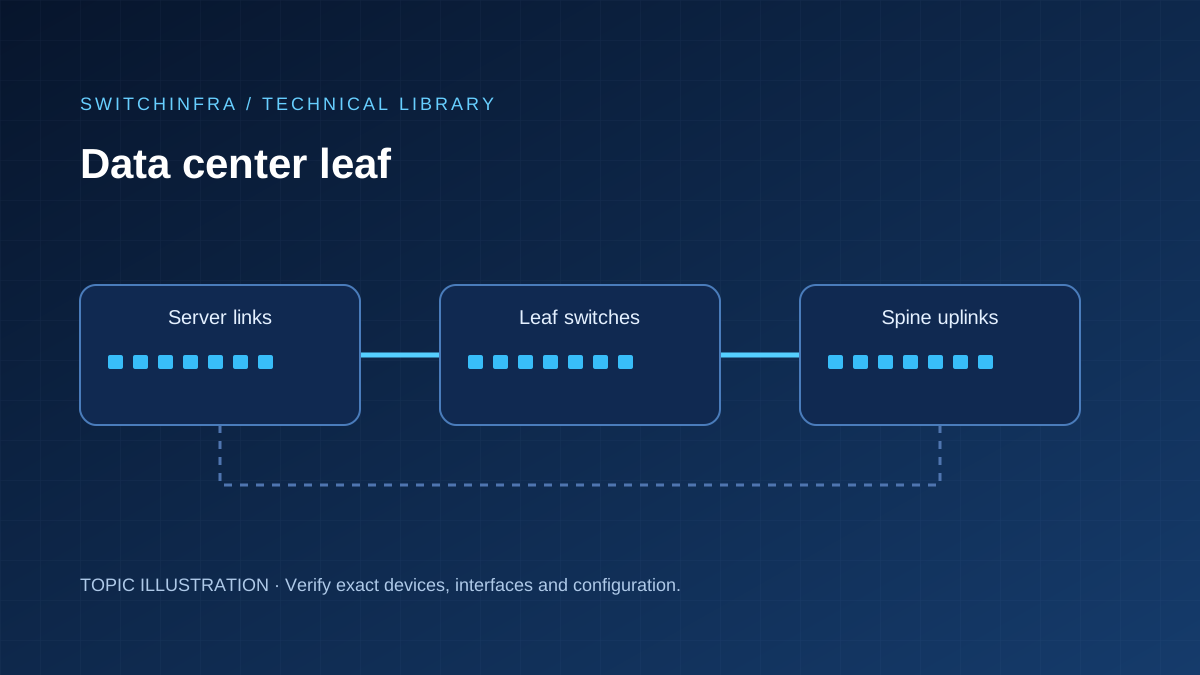
Choose leaf ports from server media, speed and fabric requirements, then validate the complete path.
The practical distinction
Link speed is a capacity input, not an application acceptance result. RoCE depends on the behavior of endpoints, congestion handling and the network under load. Publish observed test conditions rather than equating an 800G or 100G label with guaranteed workload performance.
What the product details tell you
- N9K-C93180YC-EX and -FX3 provide a different access interface choice from the copper-oriented N9K-C93108TC-EX.
- N9K-C93360YC-FX2 and N9K-C93600CD-GX differ in density and high-speed interface combinations. Use the exact port map.
- NIC support, FEC, breakout modes, MTU and software configuration must agree across the deployment. A high-rate switch does not by itself prove RoCE behavior.
Applying it to a project
Map server NICs to leaf access ports and leaf uplinks to the fabric. Calculate the traffic pattern and oversubscription target. Validate loss, congestion and recovery using the actual workload before claiming application performance.
Checks that resolve the uncertainty
- Record server NIC, optics or DAC, switch port mode and software.
- Check error counters and MTU across every path.
- Test congestion and path failure with representative traffic.
Related products
Topic associations; verify the complete configuration before ordering.
- Cisco N9K-C93180YC-EX Data Center Switch
- Cisco N9K-C93108TC-EX Data Center Switch
- Cisco N9K-C93180YC-FX3 Data Center Switch
- Cisco N9K-C93360YC-FX2 Data Center Switch
- Cisco N9K-C93600CD-GX Data Center Switch